
Working in a Knowledge Whirlpool?

I’ve noticed that there is a flow to the knowledge that enters a company.  Imagine with me if we could actually see the knowledge that our teams acquire, would there be a pattern to its flow?  We would see if it stays attached to certain people or if it diffuses throughout the organization?   If the knowledge were smoke it would be an easy visual.


We’d see the smoke sticking to certain people or flowing out of certain people depending on if they are teachers or secretive/ poor communicators.  Then think company-wide, how would our “knowledge smoke” flow?  The knowledge may enter the company through experimentation, it may enter the company through a certain publication or text-book, it may enter the company through a new hire, but what is particularly important is how the knowledge flows once inside!


On some projects that I have been a part of, the knowledge enters the company through a variety of channels, experiments, literature searches, new hires, textbooks, but once inside the smoke finds itself in dozens if not hundreds of whirlpools.  The knowledge flows in one direction (up to managers) if at all.  At the start of each whirlpool is the key scientist, engineer or technician doing the learning.  When I say learning I am not only talking about using science to invent the next product or process.  Learning happens in a variety of ways; experimentation, internet research, telephone calls with vendors, employees attending conferences to name just a few.  Learning occurs all of the time, knowledge is entering our companies in a wide variety of ways and where that knowledge flows after it is in the company matters almost as much as getting the knowledge in in the first place.


Healthy organizations have free-flowing knowledge!


In a healthy culture employees are not incentivized to hold knowledge hostage until they get credit or rewards of political favor.  The knowledge that enters our companies may enter through one narrow channel but once inside it should disperse easily through a variety of channels.  Whirlpools exist when water is flowing into one narrow path, unlike a whirlpool large portions of the Nile river in South America flows slowly in over a wide area, the Rio Negro is a river basin in Brazil that flows like this.


The water flows everywhere giving life to huge area of land mass.


Does the knowledge flow in your company like whirlpools or like the Rio Negro in Brazil?


I see three exciting ways that a company can free up its knowledge flow.


  1. Use social enterprise business software, recent products that are coming out designed for employee connectivity and collaboration are amazing.  I have been researching the many options for this and I can’t recommend it enough, it is well worth the investment.  I use social business tools, and am amazed at its potential to change how companies function, like facebook and twitter have been I believe that these software tools will be company game changers, a driver of cultural change… if they are embraced.
  2. Do not reward secretive, competitive employee behavior, this is difficult because many times the most secretive and competitive employees are also the brightest and best performers.
  3. Reward teachers, reward those who are generous with knowledge internally. The effect of this shift in what leadership values in regards to knowledge sharing will gradually change the company culture.

 

What other ways can leaders “un-stick” the knowledge that flows through their organizations ? please share…

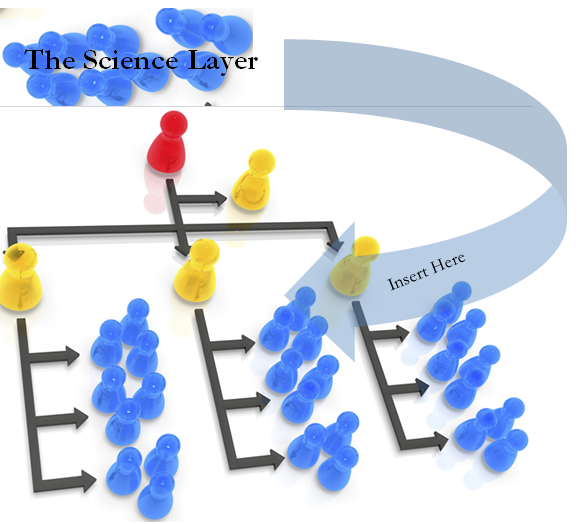
The Science Layer

I call the presence of number of scientists in an organization the “science layer”.


Quality scientists bring a unique culture to an organization that may not blend well with other employees, setting up an organizational “layer”.  Good scientists are typically highly moved by data rather than persuasive eloquence or political power. Good scientists are well-trained skeptics, are not easily manipulated. Good scientists pursue the facts without bias then spread the facts around.


I have noticed in the past few decades that a science layer is forming in high-tech R&D organizations, in our government and even in the media.  As a result of this layer I think that certain scientists and certain theories are beginning to enjoy an untouchable status.


Unlike what is happening in the government and media around science I think the presence of a significant number of scientist employees “a science layer” in companies and Universities is a healthy phenomenon.  However, having this layer present in our organization offers unique challenges for leaders within these companies.


Below are 3 ways that the presence of a science layer can bring unique challenges to R&D/ Innovation teams.


  1. Scientists have a built-in decision analysis tool that many other employees do not, which is their ability to understand things from a fundamental scientific level in their chosen field, any leader who ignores (or doesn’t understand) what the science is saying around their R&D will not easily gain the confidence of his/her team.  This is true regardless of how talented or well-trained the leader is. Sometimes the only type of leader a team of scientists will work with are older promoted scientists who easily speak their “language”.
  2. The majority of scientists are introverts, this helped them to get their credentials, it helps them to focus on study and to learn constantly. However introversion is not always conducive to healthy team dynamics and collaboration, silos can develop intentionally and internal competition is inevitable.
  3. Knowledge has a tendency to cause arrogance, knowledge “puffs people up”, a life-time of study, several decades of University education under academics and earning your living from your intellectual abilities causes many (not all) scientists to develop a stubborn superiority complex, making leading these employees challenging.


Creating healthy organizations which have a productive science layer can be challenging but not impossible.  Science layers must be acknowledged, studied and led by the right people. The science layer creates unique cultural traits that should be studied and intentionally molded to maximize the effectiveness of this critical layer in our innovation organizations.


What are some other unique challenges of employing a “science layer”?

Innovate with PATIENCE

I have a tendancy to become impatient, however like many people, the older I become the more patient I become. Patience is useful in life, I see it in my 5-year-old, impatience makes him give up way too soon, impatience makes him treat people poorly, impatience causes him to lose focus and act on fear or anger rather than principles.

Patience also is useful for innovation organizations engaging in R&D, patience can sometimes make or break these types of organizations.

It is important to in grain patience into the organizational culture for at least 3 reasons:

  1. Markets for technology are on a different timeline than technology invention. We should invent continuously and (sometimes) wait for markets to demand the inventions.

  2. Impatient organizations give up on highly talented employees before they can contribute their full value. Some employees are brilliant, creative and intelligent, some of these employees develop slowly.  Their brilliance, creativity and intelligence are highly valuable but they may not be on the same timeline as are the markets.

  3. Patient organizations communicate better because they stay focused on their core principles longer, they do not get distracted easily by hot markets, by 2-year recessions, by technology fads, or by toxic politics that come and go like the weather.

So how do we create patience in our innovation centered organizations? I think there are at least two ways, first make patience a core value, leadership should all agree that patience is valuable to the organization, then document and communicate this value often, very often, more often then you think is reasonable.

Another way to encourage patience in employee mindset is by creating a culture that values people and teams that actually get to know one another. Leaders can create promotion criteria that rewards collaboration, rewards cooperation rather than cause internal competition.  Employees and managers who have relationships with one another are more likely to be patient with one another and put up with one another’s weaknesses.

Over time organizations will see a return on their investment in patient innovation.

Is your organization patient?

Please comment on this post on twitter @Colliers2 or email me at colliersengineering@gmail.com!

Stay Up To Date With Email

​-

I use & recommend Bluehost, buy your domain and hosting here!

Get Adam’s From His Side Book Here! Its about Church Transformaton from Institutional Church to Living Ecclesia

Visitors

  • 55,631 hits

Connect on Twitter

en_USEnglish